Friday, May 13, 2016

Birkenhead Displays of 'What Lies Beneath' exhibition

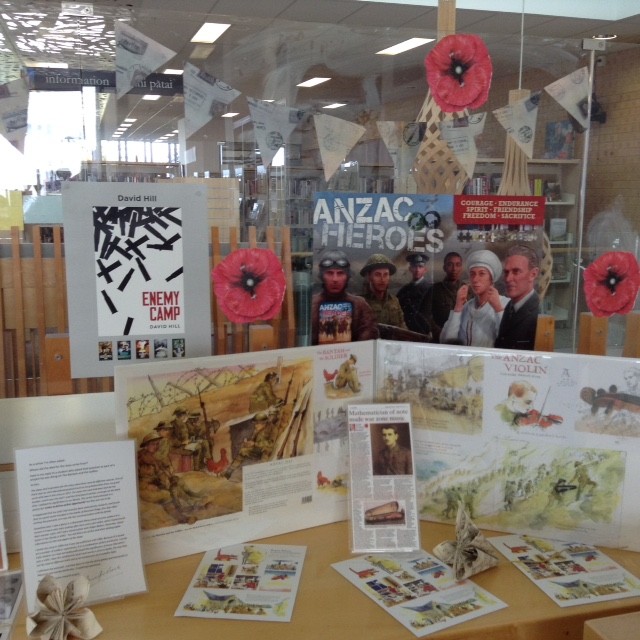
Birkenhead Library in Auckland will feature the 'What Lies Beneath' Exhibition of children's war books throughout May.  Here's a taster of their displays:


Wednesday, May 4, 2016

Introducing Glyn Harper

Glyn Harper is Professor of War Studies at Massey University in Palmerston North, New Zealand. He is Massey's Project Manager of the Centenary History of New Zealand and the First World War. A former teacher, he joined the Australian Army in 1988 and after eight years transferred to the New Zealand Army, where he rose to the rank of lieutenant colonel.

Glyn was the army's official historian for the deployment to East Timor and is the author of numerous history books for adults. His children's books include Le Quesnoy, Jim's Letters and Roly, the Anzac Donkey. In 2015 Glyn and illustrator Jenny Cooper won the Best Picture Book Award at the New Zealand Book Awards for Children and Young Adults, as well as a Storylines Notable Picture Book Award, for Jim's Letters, a moving story about a correspondence between two brothers during the First World War. In 2016 Penguin Books NZ published 'Gladys goes to War'. It has been number one in the bestseller list since its release.

We asked Glyn to answer the following questions about his book 'Gladys goes to war'.

Something Positive (happy) you discovered while writing/illustrating the book.

I     I was excited to uncover Glady's story. Such an amazing woman deserved to have her story told.
 
Something Sad (tragic) you discovered while writing/illustrating the book.

      Gladys'  husband, William Henning died in September 1918. Her two brothers also died in the war; one just days before the end of the war. She also had a severe case of influenza which permanently damaged her lungs.


      Something Interesting (that surprised you) you discovered while writing/illustrating the book.

       I was surprised that Gladys achieved so much: working on cars and as a car sales rep, learning to fly, driving across Australia and as a member of the RSL.


Thursday, April 21, 2016

Introducing Jennifer Beck


Jennifer Beck – Background

I grew up on a farm in North Auckland, as one of five children. We didn’t have many toys, which meant we had to use our imagination and make up ways of entertaining ourselves.  Both my parents loved books, and reading books was a favourite pastime.  We often played ‘word games’ around the kitchen table. Art was also important in our family, and we were encouraged to draw and paint. Later, as the parent of young children I was involved in Playcentre, and was influenced by several very creative friends.  I think these experiences helped me become a writer.


I trained as a teacher and later as an educational psychologist, and later combined writing books while working in these occupations. Although I’ve written many educational school readers, a love of art as well as writing has lead to my specialising in picture books, many of which have won awards.  These include five books which deal with war, a topic which I believe requires special sensitivity when written for children. As well as enjoying collaborating with skilled illustrators such as Robyn
Belton, Lindy Fisher and Fifi Colston, I have also illustrated one of my own books.  Although I have always valued the work of illustrators, the experience of illustrating a book myself was an extra reminder of how difficult and time-consuming this role can be!

I live on the outskirts of Auckland with my husband Peter, and enjoy family and community events, reading, watercolour painting and travel, particularly around New Zealand.

Interview Questions:  I asked Jennifer Beck if anything positive, sad or interesting happened while writing the two books. Jennifer answered:

Positive:  The Anzac Violin

For years Robyn Belton and I had talked about writing the story of Alexander Aitken. He was a Dunedin soldier who carried a violin ashore at Gallipoli, and at times managed to play it to his comrades during the campaign.  A very special experience for me was visiting Otago Boys’ High School in 2011 and being able to hold that same violin which is now a treasured memento on display at his old school.  Returning to Dunedin in 2015 as Children’s Writer in Residence at the University of Otago, with the opportunity to write the story, was a wonderful follow-up experience.  
Sad:  The Bantam and the Soldier
Robyn Belton and I wrote this picture book over twenty years ago, and it is great to have it still in print.  Although the story relates to many New Zealand families, it is also very personal for both of us, and I must confess that when reading it I get a bit emotional at times, just as I did when writing it.

Interesting:  
Research for these two books and other war stories has led to meeting many interesting people, travelling to places I would never have otherwise visited, and sometimes making surprise discoveries and links that have enhanced the original story.  Research may sound a bit dull, but it can lead to exciting discoveries such as seemingly astonishing coincidences.  


Wednesday, April 20, 2016

Introducing Peter Millett


Peter Millett loves writing humorous stories that the whole family can enjoy. His most popular NZ books are The Anzac Biscuit Man, Humpty Rugby and Moa's Ark, and his most well-known overseas titles are the Boy Zero Wannabe Hero and Johnny Danger series. His picture book The Anzac Puppy won the Children's Choice award at the 2015 NZ Book Awards.

I asked Peter Millett to tell us something positive, sad and interesting that occurred when writing the book.

1.       Positive (happy) you discovered while writing/illustrating the book.

The people of Cannock Chase hold Kiwis in the highest regard and go out of their way to honour our WW1 contribution.

2.       Sad (tragic) you discovered while writing/illustrating the book.

 The tragic case of soldiers who died on the transport ships getting to the UK before seeing any action or training.

3.       Interesting (that surprised you) you discovered while writing/illustrating the book.

 Contacting a retired UK journalist who vividly remembered interviewing Fred Smith in 1965. Fred's excellent research helped inspire my book. 


Friday, April 15, 2016

Auckland Central Library 'What Lies Beneath' display

Auckland Public Library has the 'What Lies Beneath' display for all of April. Opening Night is on Tuesday 19th April 5.00 pm - 7.00pm. If you'd like to come, please RSVP to (Ania.Biazik@aucklandcouncil.govt.nz) at the library. Panellists include:

  • Jennifer Beck - author of 'The Bantam & the Soldier'
  • Maria Gill - author of 'Anzac Heroes'
  • Marco Ivancic - illustrator of 'Anzac Heroes'
  • Di Menefy - author of '1915: Wounds of War'
  • Peter Millett - author of 'The Anzac Puppy'
  • Melinda Szymanik - author of 'A Winter's day in 1939'
We're talking about writing and illustrating children's war books for young readers. You'll also see sneak peaks of new books from the above panellists and a book launch of 'Anzac Heroes'.

John Graham has books for sale! Lots of posters and bookmarks to takeaway! We look forward to seeing you.

Here's some pics of the display to tempt you:


Some more information here.

Thursday, March 31, 2016

The 2016 What Lies Beneath Exhibition goes live!

The What Lies Beneath exhibition gets its first outing this Sunday at the Storylines Margaret Mahy Day. From Monday onwards it is at Auckland Library for the month of April and then it goes all around the country. Check out where and whose books are in the exhbition.


Tuesday, March 29, 2016

Introducing Diana Menefy


Diana Menefy            


Diana was born in Christchurch. Growing up in the South Island gave her a rich collection of experiences and images: the snow on the mountains, the autumn colours, the north-west winds - having to push her bike home as the payoff for an express ride to school.
In 1974 Diana and her husband bought the dairy farm in Tapuhi, Northland. Life on the farm with a river that flooded and three adventurous children was a great background for a budding writer.  Her first stories and articles were published in the New Zealand Farmer and School Journal in the late 1970s and early 1980s.
 For the next ten years most of her published work was non-fiction although she had several short stories in anthologies. She worked as a part-time feature writer for the local paper, then went freelance to work on commissioned histories. Running parallel with this was a passion for children's literature that culminated as the specialty for her master's degree in education in 2001.
2001 saw her first junior novel River Crossing and her sixth commissioned non-fiction book The Centenary of Whangarei Hospital  published. Learning Media accepted four of her readers for the American market and sales of Pounamu New Zealand Jade, a book aimed at the tourist market, were reaching towards 12,000. This was also the year Diana started to work for NorthTec tutoring and doing the course design for the online diplomas of applied writing. She is now a principal academic staff member at Northtec.
In 2010 Shadow of the Boyd was published by HarperCollins and went on to be shortlisted in the N.Z. Post Children’s Book Awards and won the LIANZA Esther Glen Medal in 2011. In 2013 Diana was asked to write one of the Kiwis at War series for Scholastic.  1915: Wounds of War was published in 2015.

1915: Wounds of War
Teaching notes: http://www.scholastic.co.nz/Club/pdfs/1915_wounds_of_war.pdf
ISBN: 9781775432746
RRP $19.00